


Many community members want to better understand the present state of play, what's currently happening at the Moree Artesian Aquatic Centre (MAAC), and why Council is looking at an alternative option for development of the 50-metre pool at Taylor Oval.
This page has been set up to keep you in the loop.
Since 2020, the Moree Plains community has unfortunately lacked a 50m pool, meaning many children have been unable to participate in swimming lessons. Council has responded to the initial issues that led to the demolition of the 50m pool, but additional issues – in particular, leaks – continue to be discovered at the MAAC.
Despite a lot of work to address leaks and other failing infrastructure, there's no guarantee that more leaks won't occur.
There is no perfect answer, but waiting another five years for a pool is not an option. So Council is looking to progress the best available solution.
To stay abreast of future updates, bookmark this page and stay tuned to Council's Facebook.
Background to the MAAC and the 50m pool
The history of the MAAC provides context for some of the current issues.
- 1913 – the original six-lane, 60-yard pool was built.
- 1965 – the Freedom Ride and protests occurred at the MAAC in February 1965, leading to a National Heritage Listing.
- 1977 – facility improvements, with the addition of some of the brick buildings and amenity facilities, as well as the two open-air hot pools.
- 2011 – extensive redevelopment of the facility, with the demolition of all existing pools to develop:
- a new eight-lane, 50m outdoor pool.
- the program pool.
- the children's splash area.
- the installation of new water filtration systems.
- the construction of two new hot spa pools.
- the conversion of the eastern wing and the enclosed hot artesian pool into the gymnasium, café, and administration offices.
- the conversion of the western wing and the reconfiguration of the enclosed artesian pool into the Wellness Centre.
- construction of the water slide.
- 2012 – issues and defects with the redeveloped MAAC emerge.
- 2020 – the 2011 50m pool was decommissioned and eventually demolished due to structural failure.
- 2023-24 – The program and wellness pools were refurbished and the splash park was removed due to water leaks.
- 2024 – construction of a new 50m pool, grandstand and associated earthworks commence, with a review of environmental factors.
- 2025 – refurbishment of the passive and active hot pools.
Other critical issues at the MAAC
- Incorrect pipe sizes and fittings have been applied – both by trying to fit incorrect sized pipes to existing pipes, as well as the use of pipes and other infrastructure that didn't meet required standards.
- The plant was due to be replaced in 2016, but continued to operate, resulting in failures that saw SafeWork NSW close the facility in January 2025 to address issues with pumps and pipelines for the transfer of chlorine and hydrochloric acid, leading to the installation of a new chlorine storage tank.
- General deterioration of the facility’s equipment, including switchboards, controllers, and pumps that have passed their functional service life.
- Failed sand filters, hot water systems and showers as recently as July 2025.
- The closure of the program pool in December 2024 due to a filter failure.
- Overall failure to adhere to the asset maintenance and replacement schedules, contributing to resourcing and budgetary constraints.
Leaks
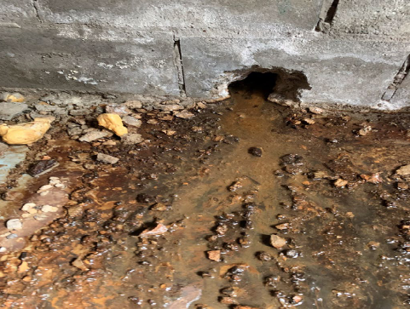
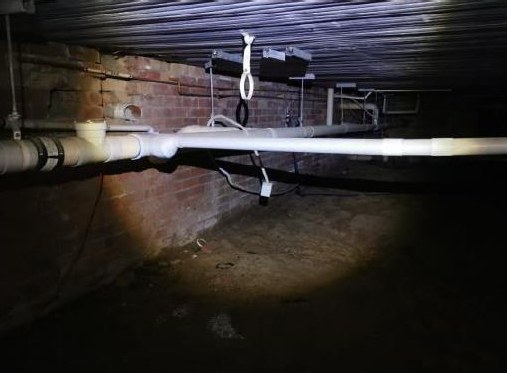
Multiple pools, buildings and facilities leak, with investigations resulting in further leaks being found.
- Earthworks for the new 50m pool commenced in March 2024, but were halted shortly after excavation commenced, as the contractor thought they'd hit an underground spring due to the volume of water found. Analysis showed it to be artesian water, which highlighted that the leakage is from the MAAC. The presence of this water meant earthworks had to halt.
- The artesian leaks contributed to toilet, change rooms, pipe work and fitting failures (although some of this is also associated with movement of the existing buildings). This has caused waterproofing of amenities to fail, contributing to leaking under the buildings housing those facilities.
- The 2011 active and passive hot pools were built inside the shell of the 1913 pool, having retained the concrete slab underneath, with topping slab poured that has since been found to be of poor quality. This contributed to a substantial amount of the leakage, however this was not evident until these pools were demolished. Both the active and passive hot pools are in the process of being rebuilt.
- The newly constructed Wellness Centre was also leaking water, undermining its foundations.
- Further leak detection undertaken in early 2025 found the decommissioned children’s splash area had been leaking water for three years because one of the pipes servicing it had not been capped properly.
- As of August 2025, an active leak continues underneath the MAAC, which is apparent around the splash pad area.
- One of the ongoing risks is ground movement, contributed to by leaks under the buildings, leading to a need to reroute drainage.
- A heavy storm event in 2024 presented roof leaks, the roof having bowed due to the weight of the solar panels installed.
Council has engaged plumbing services to investigate, a process which sees each element investigated one by one to eliminate them as a source of leak. Complicating this task is an absence of accurate drawings from the 2011 redevelopment – a result of both poor filing and staff turnover.
Leak investigations have also been delayed due to the need to undertake maintenance work on hot-water systems, wet areas, change rooms, as well as pumps and other facilities.
Addressing these issues
Roejen Engineering Services provided Council with an asset condition report in December 2024.
Trisley’s Hydraulic Services are improving equipment maintenance and supporting local contractors.
Remaining financials
Grant money for the project is specifically for a 50m pool, grandstand and tiered seating, the result of the following generous grant funds:

- Approximately $10 million from the Australian government.
- Approximately $8 million from the NSW government.
- Approximately $5 million from Council.
Some of this amount has been spent on work at the MAAC, while most of the rest is approaching expiry, so Council will submit variation requests to the relevant government agencies to extend this funding.
Financial considerations for a new site
With the construction of a new 50m pool expected to cost tens of millions of dollars, and considering the length of time spent already to try and progress works at the MAAC, the ongoing difficulty of locating leaks and the costs to fix the issues, Council has resolved to consider an alternative site that provides some cost preservation and value for public money.
The new site needs to be:
- Owned by Council, so additional funding to purchase one (which cannot be covered by grant funds) is not required.
- Flood free, because building a pool at risk of frequent flooding requires additional construction, which elevates costs.
- Zoned appropriately and offers sufficient space for current and future needs, as well as being located close to the schools who would benefit from its use for both school carnivals and learn to swim programs.
Taylor Oval meets all these considerations.
Why Taylor Oval?
Taylor Oval is a recreation sporting precinct, with existing tennis facilities, so installing with the 50m pool is consistent with the historical use of the precinct. Further, a pool at Taylor Oval will bring both locals and tourists to the town centre, contributing to the redevelopment of Balo St.
From a financial perspective, a pool at Taylor Oval helps contain the costs.
The first time Council went to market, the only tenders received were from companies that had not built a pool before, making these tenders unacceptable.
Going back to market to call for new tenders, not one builder wanted to take on the whole project – they wanted it split up:
- Earthworks and piling as one project and contract
- Building the pool as a separate project and contract
- Concreting to be another project and contract
That's not normally what happens when you go out to market for a pool and was due in large part to the complexities of the MAAC site and the constraints of having to work around residential building.
These complexities do not make for a particularly appealing business proposition, so Council had less competition for the job – and less competition can often mean paying a higher price.
As a greenfield site where contractors do not need to work around existing infrastructure, Taylor Oval presents as a more attractive project, leading to greater competition.
History of Taylor Oval
- 1892 – first officially designated a sporting precinct, leading to the site becoming the pre-eminent Oval within Moree.
- 2005 – Council adopted a Sports Facilities Strategy, as a result of a report by Thompson Tregear that found Taylor Oval did not meet the requirements of a premium sports facility, seeing a shift towards Ron Harborne Oval.
- 2007 - Taylor Oval was entered as a burial site on the Aboriginal Heritage Information Management System (AHIMS).
- 2011 – Taylor Oval is listed as a place of Aboriginal cultural significance in Moree Local Environmental Plan.
- 2011 – the State Government supported a change in the zoning of Taylor Oval from a recreation zone to a commercial zone (redeveloped as an aquatic facility is a permissible use both in a commercial and a recreation zone).
Feasibility of Taylor Oval
Council engaged NSW Public Works on 21 March 2025 to undertake a feasibility study into the construction of a facility at Taylor Oval containing:
- 50 m pool.
- Covered grandstand and 2 x 10 m covered seating areas.
- Two-storey amenities building including change rooms, amenities, storage area and club room with deck.
- Plant room and plant equipment.
- Service desk and entry foyer.
- Security fencing with access control.
- Concreted pool surrounds and pathways.
- Car park for up to 30 vehicles.
The study found: “Taylor Oval is a suitable location for the proposed new pool given its connectivity to the town centre, its proximity to the existing sporting and community infrastructure and the local schools. It also affirms that construction is feasible, pending the completion of the design and engineering phases, including further detailed site investigations.”
The Aboriginal Heritage Information Managament System (AHIMS) listing
As per the Heritage NSW feasibility study, extensive work has already been undertaken in regards to Taylor Oval’s heritage, such as: “historical research including parish maps, oral histories, electro-magnetic subsurface imaging and a substantive program of subsurface test trenches”, which led to the conclusion, “it seems unlikely that Taylor Oval… was a specific location used as a traditional Aboriginal burial ground”.
As per the recommendation of NSW Public Works, Council has requested that Heritage NSW reviews the AHIMS listing in light of prior findings.
What has Council resolved to do?
The feasibility report prepared by Department of Public Works NSW was presented to Council at the Ordinary Council Meeting on 17 July 2025.
The report had the following scenarios:
- Scenario 1: If Heritage NSW approves Council's request for the review of the Taylor Oval site listing – a process that generally takes 60 days – a report will be brought to Council to consider concept options for construction and seeking endorsement for undertaking grant funding variation request to complete the project.
- Scenario 2: If Heritage NSW denies the request, a detailed archaeological investigation of Taylor Oval will be required. This is expected to take at least 40 weeks, during which time there be no construction occurring at Taylor Oval.
Council resolved to note the report for information and proceed with Scenario 1.
Concept site plans prepared by public works


These are early plans – not final designs – that illustrate how a 50m pool could sit on Taylor Oval.
Next steps
Pending advice from Heritage NSW, Council will progress project planning for the 50m at Taylor Oval, including consultation with the community with regard to:
- The short term concept and detailed designs for the site, including exactly what infrastructure is proposed to be built at Taylor Oval and how other uses for the site can be incorporated (such as car-parking, SES operations during flood events, green space and acknowledgement of cultural/historical significance);
- The long term master plan for the site;
- Investigation into the artesian water connection at the site.
